Galliford Try: Building Britain’s Future Through Construction and Infrastructure


Galliford Try is one of the United Kingdom’s leading construction groups. The company delivers buildings, transport networks, water projects and essential infrastructure for public bodies, private organisations and regulated industries.
Its main headquarters are in Uxbridge, Middlesex, with offices across England and Scotland. The group employs approximately 4,300 people and belongs to the FTSE 250. Its shares trade under the code GFRD.
Galliford Try operates through two important legal companies. Galliford Try Limited is an active private company with a history dating back to 1965. The current publicly traded parent is Galliford Try Holdings plc, created in 2019. This structure was formed after the group sold its housebuilding divisions to Vistry Group in January 2020.
The company works mainly in the UK. Its projects support schools, hospitals, defence facilities, roads, water networks, housing schemes and public buildings. Its regional approach allows local teams to understand community needs while benefiting from the resources of a national construction group.
Galliford Try Quick Info
| Detail | Information |
|---|---|
| Company name | Galliford Try |
| Industry | Construction and infrastructure |
| Headquarters | Uxbridge, Middlesex, United Kingdom |
| Established | 1965, with roots of more than 100 years |
| Current parent company | Galliford Try Holdings plc |
| Operating company | Galliford Try Limited |
| Company number | 00836539 |
| Employees | Approximately 4,300 |
| Stock code | GFRD |
| Main divisions | Building, Infrastructure, Specialist Services and Investments |
| Core sectors | Education, defence, healthcare, highways, water, housing and environment |
| Key brands | Morrison Construction, Oak Specialist Services, Ham Baker Engineering, Lintott and AVRS Systems |
| Website | www.gallifordtry.co.uk |
The History of Galliford Try
The organisation’s roots go back more than a century. Galliford developed from a Midlands construction business, while W.S. Try began in the South East of England. The two businesses joined together in 2000, creating a larger national contractor.
Expansion continued through major acquisitions. Morrison Construction joined the group in 2006, strengthening operations in Scotland. Miller Construction was acquired in 2014, adding further experience in building, civil engineering and infrastructure.
In 2019, Galliford Try Holdings plc was created as a new parent company. In January 2020, the group transferred its housing divisions to Vistry Group. These included Linden Homes and Galliford Try Partnerships and Regeneration. The continuing business focused on construction, infrastructure and related specialist services.
Further expansion took place through acquisitions in the water, engineering, fire protection and asset management markets. Lintott Control Systems joined after the purchase of the nmcn water business. Ham Baker Engineering became part of the group in 2022, followed by AVRS Systems in 2023. In February 2026, Nene Valley Fire & Acoustic was acquired to strengthen fire and acoustic protection services.
How Galliford Try Serves the UK
Building and Property Projects
The Building division delivers projects in education, defence, healthcare, custodial services, affordable housing and commercial property. Its work includes schools, hospitals, universities, prisons, military buildings, offices and residential developments.
The company has a strong presence in Scotland through Morrison Construction. Building teams also provide maintenance and facilities management, allowing clients to receive support after construction is complete.
Highways and Transport Infrastructure
The Infrastructure division delivers major roads, bypasses, bridges and transport improvements. It works with National Highways, local authorities and regional transport bodies.
Past projects include the Queensferry Crossing, Lincoln Eastern Bypass, the M49 Avonmouth junction and major smart motorway schemes. The group also works on city transport programmes, distributor roads and highways maintenance frameworks.
Water and Environmental Services
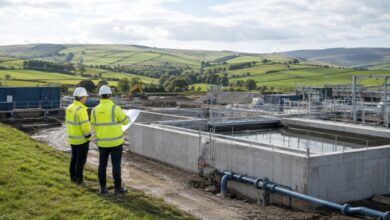
Water and environmental work forms another major part of the business. Galliford Try works with water companies across England and Scotland on treatment plants, pumping stations, pipelines, flood protection and wastewater improvements.
Projects have included Keadby Pumping Station, Scottish Water programmes, Southern Water schemes and Yorkshire Water infrastructure. These services are important as the UK faces ageing water networks, climate risks and stricter environmental standards.
Specialist Services and Investments
Specialist activities include facilities management, digital infrastructure, fire protection, security systems, building remediation and private-rented-sector investment.
The Investments division uses experience in public-private partnerships and property development. This gives the group additional opportunities beyond traditional construction work.
Galliford Try Brands and Specialist Businesses
The group operates through several recognised brands.
Morrison Construction is a major Scottish contractor working across building and infrastructure. Oak Specialist Services focuses on facades, cladding remediation, passive fire protection, green retrofit and building-fabric surveys.
Asset Intelligence provides physical security, electronic protection and integrated systems for important buildings and critical infrastructure. Ham Baker Engineering supports water and wastewater assets through inspection, maintenance and specialist equipment.
Lintott Control Systems designs packaged treatment systems, electrical control panels and process software for the water industry. AVRS Systems provides mechanical and electrical design-build services, mainly for water and energy projects.
Together, these businesses help the group offer complete solutions from design and construction to maintenance and long-term asset support.
Galliford Try Financial Performance
For the financial year ending 30 June 2025, the group achieved revenue of approximately £1.9 billion. Adjusted profit before tax reached about £45 million, while the divisional operating margin rose to 3.0%.
The order book stood at £4.1 billion. The company had already secured 92% of expected revenue for the following financial year and 75% for the year after that. Average month-end cash reached £179 million, showing a strong financial position.
During the first half of financial year 2026, revenue reached £934.9 million. Adjusted profit before tax was £24.7 million, adjusted operating profit was £21.6 million and net cash stood at £211.7 million. The order book remained close to £4.1 billion.
Building produced £476.5 million of revenue, while Infrastructure produced £454.2 million. The group also maintained undrawn banking facilities, giving it additional financial flexibility.
The Strategy Behind Galliford Try
The company’s strategy aims to achieve revenue above £2.2 billion and a divisional operating margin of 4.0% by 2030.
Growth areas include affordable housing, water capital maintenance, green retrofit, fire protection, security, facilities management and private-rented-sector development. These markets can provide stronger margins and longer-term client relationships.
The group also focuses on careful project selection, repeat business and long-term frameworks. Most of its clients come from public or regulated sectors, including government departments, local authorities, education bodies, defence organisations and water companies.
Galliford Try People and Leadership
The leadership team includes Chief Executive Bill Hocking, Chief Financial Officer Kris Hampson and Chair Alison Wood. The board also includes experienced non-executive directors and senior managers responsible for Building, Infrastructure, Specialist Services and human resources.
The company places strong emphasis on apprenticeships, graduate roles and early-career development. Early-career employees make up roughly one-tenth of the workforce. Women represent about 23% of employees, while the company has also introduced career pathways and structured development programmes.
Employee advocacy has remained high, with an internal score of 87%. The group also supports volunteering, mentoring and community engagement.
Sustainability and Community Responsibility
Galliford Try aims to reach net zero for Scope 1 and Scope 2 emissions by 2030. Its wider target is net zero across Scope 1, 2 and 3 emissions by 2045.
The company uses renewable electricity tariffs, electric and plug-in hybrid vehicles, digital carbon measurement and modern construction methods. It also aims to reduce diesel use on construction sites and achieve diesel-free construction by 2035.
The environmental challenge remains significant. Site diesel emissions increased during one recent reporting period because of business growth, dewatering work, poor weather and delays in connecting sites to the electricity grid.
Community value is another important area. During financial year 2025, completed projects generated more than £1 billion in social and local economic value. Staff also contributed thousands of volunteering hours and supported charities through time, materials and donations.
Current Work and Future Growth
Recent work includes a £47.5 million Thames Water contract at Camberley Sewage Treatment Works. The company has also joined the £1.5 billion YORbuild framework and a £750 million affordable-homes framework with Sovereign.
Other opportunities include the Department for Education’s major construction framework and National Grid’s major works and civils programme. Recent Scottish projects include the Paisley Grammar School Community Campus and Hawick High School.
The Melton Mowbray Distributor Road has also gained recognition for low-carbon construction. The 7.5-kilometre scheme used digital carbon tracking, modern construction methods and lower-emission equipment.
Challenges Facing Galliford Try
Large construction groups face risks connected with rising costs, labour shortages, supply-chain pressure, design changes and complex contracts.
Galliford Try was recently replaced by Kier and Breheny on a Sizewell C road package after the parties failed to agree final commercial terms following a long early-contractor-involvement period.
The Worthing Integrated Care Centre also faced delays connected with legionella and water-system issues. These matters show why technical quality, contract management and risk control remain essential in major construction projects.
Why Galliford Try Matters
Galliford Try has developed from a traditional contractor into a broad UK construction and infrastructure group. Its strength comes from experienced regional teams, strong cash resources, long-term frameworks and a growing range of specialist services.
With major work in education, defence, healthcare, highways, water, housing, fire protection and retrofit, the group remains an important contributor to Britain’s built environment. Its future success will depend on maintaining project quality, protecting margins and delivering its ambitious growth and sustainability targets.
Also Read