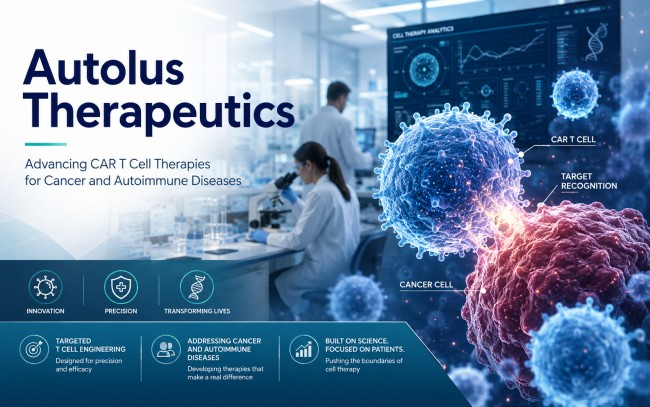
Autolus Therapeutics is a British biotechnology company focused on developing advanced CAR T cell therapies for cancer and autoimmune diseases. The business uses cell programming technology to create treatments designed to target harmful cells with greater control and precision.
The company was founded in 2014 as a spin-out from University College London. Its scientific foundation came from advanced cell programming work pioneered by Dr Martin Pule. Since then, the business has developed from an academic biotechnology venture into a commercial-stage company with its own manufacturing facilities, clinical programmes and approved medicine.
Autolus Therapeutics plc is headquartered at The Mediaworks, 191 Wood Lane, London, England. The current parent company was incorporated on 2 February 2018 and became a public limited company later that year. Its American Depositary Shares trade on Nasdaq under the symbol AUTL.
History of Autolus Therapeutics
The story began with scientific work led by Dr Martin Pule at the UCL Cancer Institute. His research focused on programming T cells so they could recognise and attack specific disease targets. Autolus was created in 2014 to develop this science into medicines for patients. During its early years, the company raised significant investment to build research, development and manufacturing capabilities.
Autolus Therapeutics completed its Nasdaq initial public offering in June 2018. This provided further capital to support clinical studies and the development of its CAR T technology.
Growth into a Commercial-Stage Business
A major turning point came in November 2024 when the US Food and Drug Administration approved the company’s first commercial treatment, AUCATZYL. The medicine later gained approval in the United Kingdom and European Union. These achievements moved the business beyond clinical development and into commercial cell therapy.
Autolus Therapeutics – Quick Info
| Quick Info | Details |
|---|---|
| Company Name | Autolus Therapeutics plc |
| Founded | 2014 |
| Founder | Dr Martin Pule |
| CEO | Dr Christian Itin |
| Headquarters | London, England, UK |
| Industry | Biotechnology |
| Specialisation | CAR T-cell therapies |
| Therapeutic Focus | Cancer and autoimmune diseases |
| Main Product | AUCATZYL® (obecabtagene autoleucel) |
| FDA Approval | 8 November 2024 |
| Main Manufacturing Site | The Nucleus, Stevenage, UK |
| Employees | 754 at the end of 2025 |
| Stock Exchange | Nasdaq |
| Ticker Symbol | AUTL |
| Intellectual Property | 95+ patent families |
| Website | www.autolus.com |
What Does Autolus Therapeutics Develop?
Autolus Therapeutics’s main scientific field is chimeric antigen receptor T cell therapy, commonly known as CAR T therapy. CAR T treatment begins with T cells collected from a patient. Scientists modify these cells so they carry a receptor designed to recognise a target linked to disease. The modified cells are then expanded and returned to the patient, where they can identify and attack targeted cells. Autolus focuses on autologous therapy, meaning the treatment is produced using the patient’s own cells.
Advanced Cell Programming
Autolus Therapeutics has developed a modular approach to cell programming. This allows scientists to add different features to T cells depending on the needs of a disease. Its technology aims to improve T cell activity, targeting, persistence and control. The company states that its intellectual property portfolio contains more than 95 patent families.
AUCATZYL and the Commercial Breakthrough
What Is AUCATZYL?
AUCATZYL is the brand name for obecabtagene autoleucel, also known as obe-cel. It is a CD19-directed autologous CAR T cell therapy. CD19 is a protein found on B cells and is an important treatment target in certain blood cancers. The US FDA approved AUCATZYL on 8 November 2024 for adults with relapsed or refractory B-cell precursor acute lymphoblastic leukaemia, known as B-ALL. This approval was one of the most important milestones in the company’s history.
How the Therapy Works
AUCATZYL uses a CAR designed with a fast target-binding off-rate. This means the engineered T cell can engage with its target and then disengage relatively quickly. The design is intended to maintain cancer-fighting activity while reducing excessive T cell stimulation. The goal is to support strong activity and longer T cell persistence.
Clinical Evidence Behind AUCATZYL
The pivotal FELIX clinical study supported the development of obe-cel in adult B-ALL. The programme included patients whose disease had returned or had failed to respond to earlier treatments. Clinical findings demonstrated meaningful remission in many treated patients.
Like other CAR T medicines, AUCATZYL also carries important safety risks. These can include cytokine release syndrome and neurological effects. Patients therefore require specialist assessment, treatment and monitoring at qualified medical centres.
Autolus Therapeutics in the UK and Europe
The UK Medicines and Healthcare products Regulatory Agency granted conditional marketing authorisation for AUCATZYL in April 2025. The National Institute for Health and Care Excellence later recommended the treatment for eligible NHS patients aged 26 years and older under an agreed commercial arrangement.
Commercial sales in the UK began in January 2026. The European Commission also granted marketing authorisation in July 2025 for eligible adults aged 26 years and older with relapsed or refractory B-cell precursor ALL. Commercial expansion across Europe depends on national pricing, reimbursement and market access decisions.
Autolus Therapeutics Pipeline
Autolus is developing therapies beyond adult B-ALL. Its wider clinical strategy covers blood cancers, solid tumours and autoimmune diseases.
Paediatric B-ALL
The CATULUS programme is studying obe-cel in children and younger patients with relapsed or refractory B-ALL. The company is also developing AUTO1/22, which targets both CD19 and CD22. A dual-target approach may help address disease cells that change or lose one target.
Autoimmune Diseases
One of the most important areas of expansion is autoimmune disease. The CARLYSLE programme is studying obe-cel in severe refractory systemic lupus erythematosus. The LUMINA programme focuses on lupus nephritis, a serious condition in which lupus damages the kidneys. The BOBCAT programme is evaluating the treatment in progressive multiple sclerosis. These programmes reflect a broader scientific idea: removing harmful B cells through CAR T therapy may allow parts of the immune system to rebuild in a healthier form.
Other Cancer Programmes
AUTO8 is being studied in plasma cell diseases, including multiple myeloma and light-chain amyloidosis. AUTO6NG is focused on GD2-positive solid tumours such as neuroblastoma. The company has also developed programmes aimed at peripheral T-cell lymphoma and other difficult cancers.
The Nucleus Manufacturing Facility
Autolus operates a major CAR T manufacturing facility called The Nucleus in Stevenage, Hertfordshire. The purpose-built site covers about 70,000 square feet and is designed for commercial cell therapy manufacturing. Its production process is fully enclosed and semi-automated. This is important because every autologous CAR T treatment must be produced for an individual patient.
The facility gives the company greater control over production, quality, capacity and delivery times. External partners also support parts of the supply chain, including lentiviral vector production and US distribution.
Leadership and Management
Dr Christian Itin serves as Chief Executive Officer. He has led the company since 2016 and previously held senior leadership roles in biotechnology, including serving as chief executive of Micromet. Dr Martin Pule is the founder and Chief Scientific Officer. He remains closely connected to the scientific development of the company’s cell programming technology. Other senior leaders work across finance, operations, technology, clinical development, commercial strategy, regulatory affairs, legal affairs and human resources.
Partnerships and Strategic Relationships
Autolus has developed relationships with major academic, investment and pharmaceutical organisations. University College London remains important because the company’s original technology came from research conducted there.
BioNTech established a major strategic relationship with the business, including investment and rights connected with selected cell therapy programmes. Blackstone Life Sciences has also provided major financial and strategic support. Other relationships involve Bristol Myers Squibb, Moderna, Cabaletta Bio, AGC Biologics and Cardinal Health. These partnerships provide expertise, funding, technology access, manufacturing support and commercial infrastructure.
Financial Growth and Commercial Performance
Commercial revenue has increased strongly since the launch of AUCATZYL. The medicine generated approximately $74.3 million in net product revenue during 2025. During the first half of 2026, product revenue reached approximately $71.9 million. Second-quarter 2026 product revenue was $45.7 million, representing strong year-on-year growth. Following this performance, management increased full-year 2026 AUCATZYL revenue guidance to $140 million to $150 million.
Autolus Therapeutics remains loss-making because it continues to invest heavily in research, clinical programmes, manufacturing and commercial expansion. At 30 June 2026, it held approximately $201.6 million in cash and marketable securities. A financing agreement with Perceptive Advisors also provides access to additional capital under agreed conditions.
Employees, Culture and Values
Autolus employed 754 people at the end of 2025. A restructuring programme announced in 2026 included a workforce reduction of approximately 13% as management worked to lower operating costs. The company describes its culture as flexible, diverse and focused on creativity, leadership and teamwork. Its central purpose is to develop medicines that can provide major benefits for people facing serious cancers and autoimmune disorders.
Future of Autolus Therapeutics
The company’s future depends on two main areas: continued commercial growth of AUCATZYL and successful development of its wider clinical pipeline. Future clinical results in lupus, lupus nephritis, multiple sclerosis, paediatric leukaemia and plasma cell diseases could broaden its role within cell therapy. At the same time, the company must manage high development costs, specialist manufacturing needs, competition and complex reimbursement systems.
Autolus Therapeutics has already completed a significant transformation from a university spin-out into a commercial biotechnology company with an approved CAR T treatment, its own manufacturing base and international ambitions. Its next stage will depend on whether it can turn its expanding science and growing commercial platform into a broader portfolio of successful therapies.