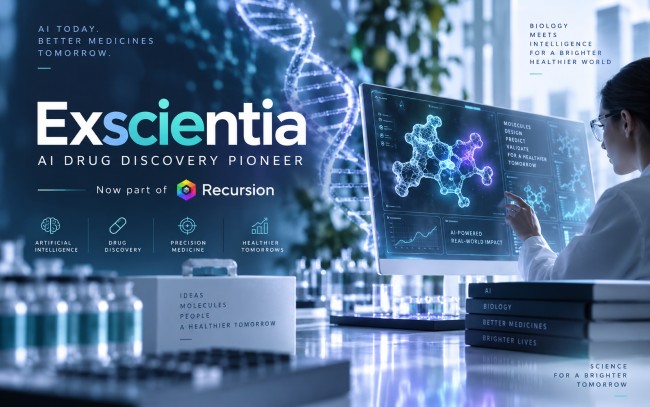
Exscientia became a leading British biotechnology company using artificial intelligence to create medicines. It combined AI, chemistry, biology and precision medicine to make drug discovery faster. The company grew from university research into a business with pharmaceutical partners and clinical programmes. Today, the business is no longer independent. Recursion Pharmaceuticals completed its acquisition in November 2024, bringing its technology and drug programmes into an AI-driven discovery platform.
What Is Exscientia?
Exscientia was a biotechnology company focused on AI-assisted drug design and development. Its technology helped scientists study chemical and biological data, identify promising molecules and improve them before costly stages of clinical development. Its work covered AI drug discovery, precision medicine, pharmaceuticals and technology. Oncology became a major focus, while partnerships also included immunology, neurological disease and other fields.
Exscientia Origins and Founder
Professor Andrew Hopkins founded the business from research at the University of Dundee’s School of Life Sciences. The original operating company was incorporated in Scotland in July 2012, supporting 2012 as the strongest date for its origins.
Some corporate pages have used 2013 as the founding year. A later parent company was incorporated in June 2021 before the business entered public markets. These dates relate to different stages of the organisation rather than unrelated company histories.
From Dundee to Oxford
Oxford later became a key centre for the business, while operations also extended to Vienna, Boston, Dundee and Miami. The company brought together experts in software, chemistry, biology, clinical science and drug development. Its model placed artificial intelligence at the centre of research rather than using it only as an extra tool.
Exscientia Quick Info
| Detail | Information |
|---|---|
| Name | Exscientia |
| Founded | 2012 |
| Founder | Professor Andrew Hopkins |
| Origin | University of Dundee, Scotland |
| Industry | Biotechnology Research |
| Speciality | AI Drug Discovery, Precision Medicine |
| Major Focus | Oncology and Drug Development |
| Former Nasdaq Ticker | EXAI |
| Former Headquarters | Oxford, United Kingdom |
| Current Parent Company | Recursion Pharmaceuticals |
| Acquisition Completed | 20 November 2024 |
| Website | www.recursion.com |
| Current Status | Part of Recursion |
How Exscientia Used Artificial Intelligence
Traditional drug discovery can take years and require testing many compounds. The company aimed to shorten this process by using AI to predict which molecules had the strongest balance of useful properties. One of its best-known systems was Centaur Chemist. It combined machine learning, predictive models and chemical design tools to study factors such as potency, selectivity, absorption, metabolism and safety concerns.
Centaur Chemist and Molecule Design
Centaur Chemist used multi-parameter optimisation, meaning it could consider several drug qualities at the same time. This was important because a molecule might work strongly against a disease target but still fail because of poor absorption, instability or toxicity. Generative methods could create many possible chemical structures. Active learning then helped scientists decide which compounds were worth testing.
Precision Medicine
The company also strengthened precision medicine by acquiring Austrian business Allcyte in 2021. Its technology could study how living tumour samples from individual patients responded to different treatments at single-cell level. This helped connect drug design with patient biology. The aim was not only to create promising medicines, but also to understand which patients might benefit most from them.
Exscientia and the DSP-1181 Milestone
A breakthrough came through work with Sumitomo Dainippon Pharma. The partnership created DSP-1181, a serotonin 5-HT1A receptor agonist developed for obsessive-compulsive disorder. The candidate entered a Phase I clinical study in Japan in January 2020. Its discovery stage took less than 12 months, far shorter than the multi-year process often associated with traditional early drug development. DSP-1181 later failed to meet the expected evaluation criteria and development was stopped. The outcome showed that AI can speed up discovery, but clinical success still depends on safety and effectiveness in people.
Exscientia Drug Pipeline
Oncology programmes created by the company later became part of Recursion’s pipeline.
REC-617
REC-617, formerly GTAEXS617, is a CDK7 inhibitor being studied in advanced solid tumours. It continues as part of Recursion’s oncology development work.
REC-3565
REC-3565, formerly EXS73565, targets MALT1 and is being studied in B-cell malignancies. It entered Phase I development as another programme produced through AI-led chemistry.
REC-4539
REC-4539, formerly EXS74539, targets LSD1 and was designed for oncology. The molecule was created with the aim of balancing anti-cancer activity with improved safety.
An earlier programme, EXS21546, was discontinued after development priorities were reviewed.
Major Exscientia Partnerships
Partnerships were central to the business. The company worked with pharmaceutical groups to apply its technology across different diseases.
Sanofi
In 2022, it began a collaboration with Sanofi covering up to 15 small-molecule programmes in oncology and immunology. The agreement included a $100 million upfront payment and the possibility of future milestone payments.
Merck KGaA
In 2023, the company entered a multi-year collaboration with the healthcare business of Merck KGaA, Darmstadt. Initial work covered oncology, neuroinflammation and immunology.
Other Pharmaceutical Partners
The business also worked with Celgene, later part of Bristol Myers Squibb, as well as Evotec, Sumitomo Pharma, Bayer, GSK and other organisations. These partnerships expanded its reach and supported the development of its AI platform.
Funding and Nasdaq IPO
Exscientia attracted investment as interest in AI-led biotechnology increased. Evotec invested in 2017, followed by later financing rounds including Series B, Series C and a Series D led by SoftBank Vision Fund 2. In October 2021, the company completed its Nasdaq initial public offering under the ticker EXAI. Its American Depositary Shares were priced at $22 each, giving the company new funding for research and development.
Leadership Change in 2024
Professor Andrew Hopkins served as chief executive for many years. In February 2024, the board removed him as chief executive and director after an internal investigation into relationships with two employees that the board considered inconsistent with company standards. Chief Scientific Officer David Hallett became interim chief executive. The company stated that the matter did not affect its financial statements, internal controls or operational performance.
Exscientia Becomes Part of Recursion
Recursion Pharmaceuticals agreed to acquire the company in 2024. The transaction was completed on 20 November 2024 after the required approvals. The company became a wholly owned subsidiary of Recursion, and EXAI securities stopped trading on Nasdaq. The accounting value of the acquisition was about $630 million.
Why the Combination Mattered
Recursion brought biological data, automated experiments and computational systems. Exscientia contributed AI-led chemistry, molecular design and precision medicine. The combination created a wider platform covering target discovery, molecule design, synthesis, testing and clinical development. Centaur Chemist became part of Recursion’s technology system, while former clinical candidates continued under new REC programme names.
Is Exscientia Still Active?
The brand is no longer an independent public biotechnology company, but its UK legal entities continue to exist. EXSCIENTIA LIMITED remains an active private company controlled by Recursion Pharmaceuticals. Its registered office is at 4th Floor South, 3 Pancras Square, King’s Cross, London. The legal company structure remains active even though the public-facing business now operates under Recursion.
The Lasting Impact of Exscientia
Exscientia helped move AI drug discovery from a promising concept into real pharmaceutical development. Its work demonstrated how machine learning could support molecule design, candidate selection, precision medicine and clinical research. Its journey also proved that AI does not remove the risks of developing medicines. Drug candidates can still fail, clinical trials remain essential and scientific judgement remains critical.
From its Dundee roots to Nasdaq and then the Recursion acquisition, Exscientia became a strong example of how artificial intelligence, biotechnology and medicine can work together. Its name may now sit within Recursion, but its technology and drug programmes continue to shape the future of modern drug discovery.
Also Read