Horizon Lines LLC: The Rise, Reach and Lasting Legacy of an American Shipping Giant

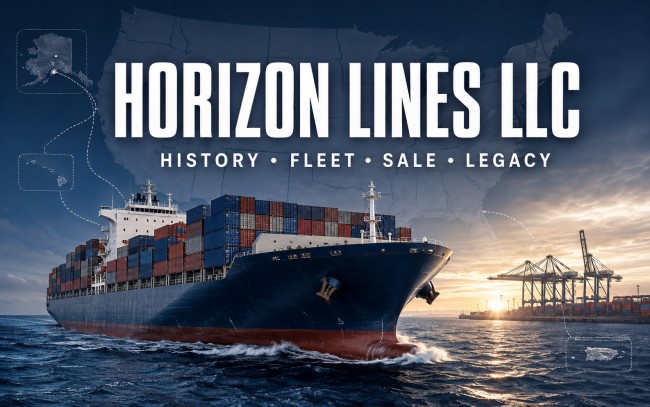
Horizon Lines LLC played a major role in ocean transport across the United States. Its ships carried food, household goods, building materials, vehicles, mail and supplies to communities beyond the mainland. Its strongest routes connected the continental United States with Alaska, Hawaii and Puerto Rico.
Horizon Lines LLC and Its Corporate Identity
Horizon Lines LLC was a Delaware limited liability company based in Charlotte, North Carolina. Its federal employer number was 56-2098440, and its SEC identification number was 0001320222. Its main activity was domestic coastal freight transport. The operating company must be separated from Horizon Lines, Inc., its parent holding company. Public shares belonged to the parent, not the limited liability company. Horizon Lines, Inc. traded on the New York Stock Exchange under HRZ. After financial problems and removal from the exchange, its shares moved to the over-the-counter market under HRZL.
From Sea-Land to Horizon Lines LLC
The business traced its roots to Sea-Land Service, founded in 1956. Sea-Land helped develop container shipping and began Puerto Rico service in 1958. Year-round Alaska service followed in 1964, while Hawaii and Guam joined the network in 1987. In 1999, CSX sold Sea-Land’s international operations to Maersk but kept the domestic routes as CSX Lines LLC. In 2003, an investor group connected with Carlyle bought most of the company and renamed it Horizon Lines LLC. A new parent, Horizon Lines, Inc., was formed in 2004 and completed its initial share offering in 2005 at ten dollars per share.
Horizon Lines LLC Quick Information
| Label | Quick Information |
|---|---|
| Company Name | Horizon Lines LLC |
| Founded | 1956 business heritage |
| Headquarters | Charlotte, North Carolina, USA |
| Industry | Ocean shipping and logistics |
| Main Services | Container shipping, refrigerated cargo and inland logistics |
| Key Markets | Alaska, Hawaii and Puerto Rico |
| Historical Fleet | 11–13 Jones Act vessels |
| Employees | 1,633 employees in 2014 |
| Former CEO | Steven L. Rubin |
| Former Stock Symbol | HRZL |
| Puerto Rico Closure | Operations ended in 2014–2015 |
| Hawaii Business | Sold to The Pasha Group in 2015 |
| Alaska Business | Acquired by Matson in 2015 |
| Current Status | Subsidiary within the Matson corporate structure |
| Website | www.horizonlines.com |
How Horizon Lines LLC Built Its Shipping Network
The company specialised in markets separated from the mainland by long sea routes. It combined ocean shipping with port work, road transport, rail connections, refrigerated cargo handling and inland distribution.
Alaska, Hawaii and Puerto Rico
The Alaska service connected Tacoma with Anchorage and Kodiak twice weekly. A weekly sailing served Dutch Harbor. The Hawaii business moved containers between the US West Coast and the islands, including fresh and frozen food in refrigerated equipment. Puerto Rico was served from mainland ports including Jacksonville, Houston and Philadelphia, with San Juan as the main destination. For a period, the carrier held a rare position because it served Alaska, Hawaii and Puerto Rico at the same time. Its customers included leading retailers, manufacturers, government agencies, the Department of Defense and the US Postal Service.
A Jones Act Carrier
These domestic routes operated under the Jones Act. This law generally requires cargo moving between American ports to use vessels built in the United States, registered under the American flag, crewed mainly by Americans and controlled by American citizens. The rules protected domestic shipping capacity but made vessel replacement expensive.
Ships, Terminals, Customers and Employees
An older company description referred to thirteen vessels and five terminals. A December 2014 fleet table named twelve ships. After Horizon Trader was sold in early 2015, the company owned eleven vessels. The Alaska ships were Horizon Anchorage, Horizon Tacoma and Horizon Kodiak. The Hawaii fleet included Horizon Pacific, Horizon Enterprise, Horizon Spirit and Horizon Reliance. Reserve or relief ships included Horizon Trader, Horizon Producer, Horizon Navigator, Horizon Fairbanks and Horizon Consumer. In 2014, the company employed 1,633 people, including 1,153 represented by eight labour unions. Its ten largest customers generated one-third of yearly revenue. One major customer alone generated nine per cent.
Financial Strain and Business Decline
Consolidated revenue reached about $1.07 billion in 2012, $1.03 billion in 2013 and $1.08 billion in 2014. Net losses were about $94.7 million, $31.9 million and $94.6 million during those years. Total debt climbed from $437.8 million to $537.7 million.
The company held only about $8.6 million in cash at the end of 2014 and had a shareholders’ deficit above $145 million. Interest expense for the year was nearly $71 million. These burdens weakened its ability to replace old ships and absorb sudden costs.
A trans-Pacific service called Five Star Express linked the United States, Guam and China. Unstable freight prices, high fuel costs and operating losses made it unsustainable. Its closure in 2011 produced major restructuring and impairment charges.
Why the Puerto Rico Service Closed
The Puerto Rico operation faced weak economic conditions, growing competition, continued losses and ageing steam-powered vessels. Two ships needed an estimated $16 million to $20 million of dry-dock work in 2015. Management decided that further investment could not be justified. Sailings ended near the close of 2014, followed by final terminal work in early 2015. The withdrawal produced about $65.7 million in restructuring costs during 2014.
Major Legal and Regulatory Cases
A serious antitrust case damaged the finances and reputation of Horizon Lines LLC. In 2011, the company agreed to plead guilty to fixing freight rates and surcharges in the Puerto Rico trade between May 2002 and April 2008. The conduct also involved customer allocation between competing carriers.
The original criminal fine was $45 million. A federal court reduced it to $15 million, payable over five years, and imposed five years of probation. Former shipping executives also received criminal sentences.
Related customer claims led to a $20 million direct-purchaser settlement and rate protections. Major customers who left that settlement later received a separate $13.8 million agreement. In 2014, the company paid another $1.5 million to settle civil allegations concerning government cargo contracts.
A separate environmental case concerned false entries in a vessel’s oil record book. In 2012, the company pleaded guilty to two counts. It agreed to pay a $1 million fine, contribute $500,000 to environmental work and follow a three-year compliance programme.
The Sale and End of Independent Operations
On 29 May 2015, the business was divided through two connected transactions. The Pasha Group bought the Hawaii trade assets and liabilities for $141.5 million. It received four Hawaii ships, Hawaii Stevedores and related transport operations.
Matson acquired the parent company, its Alaska service and the remaining non-Hawaii liabilities. It paid $0.72 for each fully diluted share, valuing the equity at about $69 million. After debt repayment, the total transaction value was about $469 million.
Matson continued the Alaska route with three diesel-powered ships and terminals in Anchorage, Kodiak and Dutch Harbor. Horizon Lines, Inc. became Matson Alaska, Inc. when the deal closed. The public stock and independent Horizon brand then ended.
Where Horizon Lines LLC Stands Today
The legal company remains part of the Matson group. Its ownership chain runs from Matson, Inc. through Matson Navigation Company, Matson Alaska, Inc. and Horizon Lines Holding Corp. to Horizon Lines LLC. It retains subsidiaries connected with vessels, Guam, distribution and Alaska operations. This does not mean the old carrier has returned. No separate modern fleet, stock, chief executive or customer-facing network operates under the former brand. Current Alaska services belong to Matson, while the former Hawaii assets became part of Pasha.
Horizon Lines LLC remains important in American maritime history. It helped sustain remote communities, maintained essential supply routes and carried goods for families, businesses and government bodies. Its story also shows how debt, old equipment, legal failures and difficult market conditions can bring a billion-dollar transport company to the end of independent operations.
Also Read